CN Soft Serve CN Soft Serve

7 Best Cocktail Vending Machines for Global Buyers?

Time:2026-09-19 Author:Sophia
0%

Choosing the right Cocktail Vending Machine requires more than comparing touchscreen designs or drink counts. Global buyers must examine beverage consistency, cleaning access, payment systems, and service speed. A machine may look impressive in a hotel lobby, yet struggle during a busy festival or airport shift.

“Automation should support hospitality, not make it feel mechanical,” says Ryan Chetiyawardana, an internationally recognized beverage-industry expert. His observation matters here. Guests still expect a balanced drink, clear information, and a safe, respectful purchasing experience. Technology should reduce friction without removing responsibility.

This guide reviews seven Cocktail Vending Machine options for buyers serving hotels, resorts, cruise terminals, entertainment venues, and approved commercial locations. Each model deserves attention for different reasons. Some prioritize compact installation. Others offer larger ingredient capacity, chilled storage, recipe customization, or remote monitoring.

Small details can decide performance. Can staff replace syrup containers without tools? Does the interface remain readable under bright sunlight? How quickly can the system rinse its lines between recipes? These questions are less exciting than futuristic branding, but they reveal practical value.

Compliance also requires careful review. Buyers should confirm local age-verification rules, licensing requirements, payment standards, sanitation procedures, and responsible-service controls before installation. No machine removes those obligations.

The comparison is not perfect. Published specifications may differ from real operating conditions. A quieter pump, simpler cleaning cycle, or stronger technical support can matter more than a longer menu. Use these seven selections as a starting point, then test each machine against your venue, staff, traffic patterns, and customer expectations.
7 Best Cocktail Vending Machines for Global Buyers?

What Are Cocktail Vending Machines and How Do They Work?

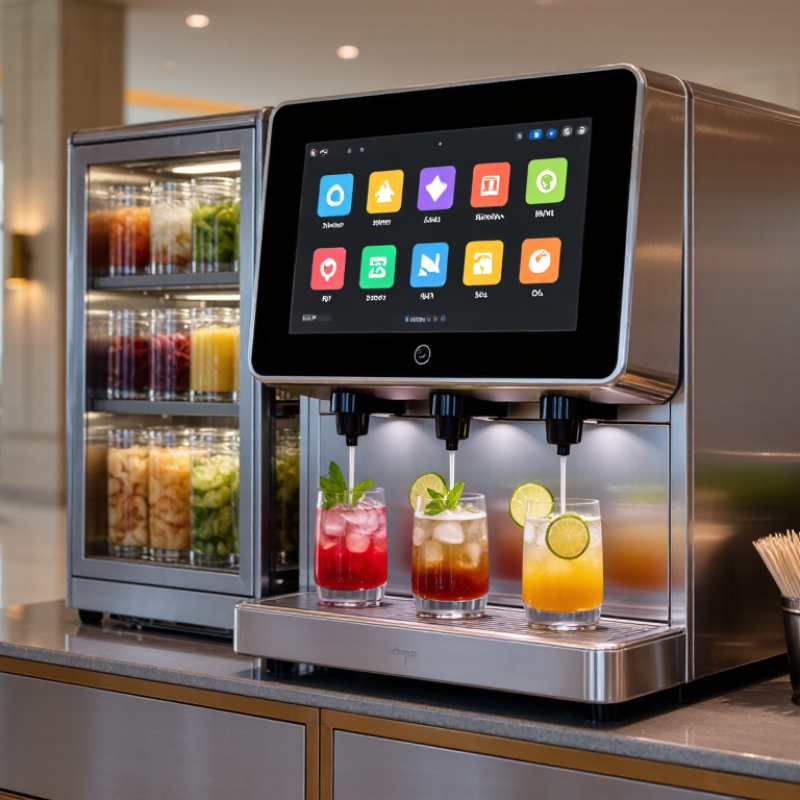
Cocktail vending machines are automated beverage systems designed to prepare measured drinks with limited staff involvement. They usually combine sealed ingredient containers, a chilling unit, a mixing chamber, and a touchscreen interface. Some models also include ice dispensing and contactless payment functions. The machine follows a programmed recipe, measures each ingredient, mixes the drink, and releases it into a cup. The process can take less than a minute.

In real installations, performance depends on more than attractive design. Ingredients must remain at suitable temperatures, while pumps require regular cleaning and calibration. Water quality also matters, especially for machines using ice or dilution systems. Operators should select recipes that match local customer preferences and available ingredients. A reliable unit should provide clear maintenance alerts, secure access controls, and records for cleaning and supply checks. It is not magic. Poor servicing can create inconsistent flavor, slow service, or equipment damage.

Tips: Check the machine’s sanitation process before purchase. Ask how quickly containers can be replaced. Test several recipes during a live demonstration. Confirm that payment, age-verification, electrical, and food-safety features suit the installation location. Local rules may differ, so professional compliance advice is sensible. Also, leave space around the unit for ventilation and maintenance. A compact machine may still need careful planning.

How to Evaluate Cocktail Vending Machines for Global Buyers

For global buyers, evaluating cocktail vending machines requires more than counting recipes or judging a bright touchscreen. Start with beverage quality, chilling speed, dosing accuracy, and cleaning access. The machine should maintain stable temperatures and record batch data. Food-contact parts need clear sanitation procedures and appropriate local certifications. IWSR Drinks Market Analysis reported that the no- and low-alcohol market could grow by 7% annually from 2023 to 2027. This suggests growing demand for controlled, consistent servings, but it does not guarantee strong cocktail sales everywhere.

Compare seven machines using the same scorecard. Check hourly output, cup sizes, ingredient storage, water filtration, payment languages, voltage options, and remote diagnostics. A practical trial should measure service time during peak periods, not just laboratory performance. Research from Grand View Research valued the global vending machine market at about $21.8 billion in 2023, showing broad automation momentum. Still, cocktail equipment faces stricter hygiene, age-checking, labeling, and alcohol-service requirements. Those rules vary widely between countries and locations.

Tips: Ask for cleaning logs, failure-rate data, warranty terms, and spare-part delivery times. Test the machine with cold storage partly loaded. That detail matters. Confirm that payment systems support local currencies and privacy requirements. A polished interface can hide weak refrigeration or expensive maintenance. I would not trust a supplier’s “plug-and-play” claim without an on-site inspection. No scorecard is perfect. Weather, foot traffic, and local taste can change results quickly. Choose measurable reliability over impressive menus.

Seven Leading Cocktail Vending Machines Compared by Key Features

7 Best Cocktail Vending Machines for Global Buyers?

Seven Leading Cocktail Vending Machines Compared by Key Features

Choosing a cocktail vending machine requires more than checking its appearance. A reliable comparison should examine capacity, refrigeration, payment systems, cleaning access, and service support. Machine One suits compact venues with a small ingredient reservoir. Machine Two offers faster dispensing for busy hotel lobbies. Machine Three focuses on precise portion control, while Machine Four provides a wider menu and touchscreen guidance. Small differences matter.

Machine Five stands out for modular storage and quick ingredient replacement. Machine Six includes stronger remote monitoring, helping operators track temperature, stock, and maintenance alerts. Machine Seven is designed for outdoor or semi-outdoor placement, but weather protection must be verified carefully. I would not trust a claimed capacity without testing real service conditions. Ice, syrup, and cup sizes can change performance.

Safety should remain central for global buyers. Look for age-verification tools, clear ingredient labels, contactless payment options, and automatic cleaning cycles. Local licensing, alcohol-service rules, electrical standards, and data-protection requirements must be checked before purchase. Good machines also provide accessible emergency stops and documented sanitation procedures. Keep it practical. A beautiful interface cannot compensate for slow maintenance, unclear instructions, or unavailable replacement parts.

Which Cocktail Vending Machine Fits Each Business Environment?

Choosing a cocktail vending machine depends on the business environment, not only the drink menu. Hotel lobbies need quiet machines, compact footprints, and polished screens. Airports require fast service, sealed cups, and strict identity checks. Event venues benefit from high hourly capacity and quick cleaning. Restaurants may prefer a countertop unit for consistent portions. Offices and residential buildings often suit non-alcoholic cocktail machines. Campuses need alcohol-free recipes and strong access controls. Outdoor venues require weather protection, battery options, and secure payment systems.

Industry data supports this segmentation. IWSR Drinks Market Analysis reported that no- and low-alcohol volumes are forecast to grow by about 7% annually from 2023 to 2027. That trend makes alcohol-free vending useful beyond traditional bars. Grand View Research also identifies automation, contactless payment, and self-service retail as major growth drivers. Yet speed is not everything. A machine can serve 60 drinks per hour, but poor refrigeration can ruin the customer experience.

Tips: Measure peak demand for fifteen minutes, not average traffic. Check cup storage, drainage, remote alerts, and cleaning access. Require local age verification where alcoholic service is permitted. Test payment failure recovery. I have found that attractive interfaces sometimes hide weak maintenance workflows. That is a costly mistake. Ask for service response times, temperature logs, and food-contact material certificates before purchase. Pilot one machine for thirty days, then compare waste, repeat orders, and staff intervention.

7 Best Cocktail Vending Machines for Global Buyers: Which Cocktail Vending Machine Fits Each Business Environment?

The chart compares seven common cocktail vending machine configurations using a 1–5 suitability score. The assessment considers service volume, space efficiency, refrigeration needs, menu flexibility, and operational complexity. Higher scores indicate a better fit for the listed business environment.

What Global Buyers Should Check Before Purchasing a Cocktail Vending Machine

Before choosing among the 7 best cocktail vending machines for global buyers, verify the machine’s operating model, not just its appearance. Cocktail vending is still a niche category, with limited standardized performance data. Grand View Research valued the global vending machine market at about USD 56.9 billion in 2023, showing strong automation demand, but this figure does not represent cocktail machines alone. Ask suppliers for tested serving times, ingredient waste, refrigeration temperatures, and monthly maintenance records.

Safety and compliance deserve careful attention. The machine should support age verification, transaction records, cleaning alerts, and local licensing requirements. Rules differ by country, city, and venue type. Confirm whether the system can pause sales during service interruptions or temperature failures. A clear allergen display is also essential. In my experience, attractive touchscreen menus can hide weak sanitation processes. That is a costly oversight.

Tips: Request a live demonstration with ice, mixers, garnishes, and payment processing. Check whether staff can replace cartridges without special tools. Review cybersecurity controls for customer and payment data. Compare the total cost of ownership, including filters, software, logistics, and technician visits. Also test accessibility features, language options, and emergency shutoff controls. A pilot installation is wiser than a large first order. Mistakes are easier to correct when only one machine is involved.

7 Best Cocktail Vending Machines for Global Buyers: What to Check Before Purchasing
Machine Type Best-Fit Application Typical Serving Format Indicative Capacity Indicative Output Typical Utilities Key Advantages Critical Checks Before Purchase
Refrigerated Premix Cocktail Dispenser Hotels, airports, lounges, offices and indoor retail areas Chilled premixed cocktails served in cups; usually 250–400 ml Approximately 20–60 litres of product, depending on tank configuration Approximately 20–50 servings per hour Standard electrical supply; refrigeration; potable-water or sanitation access may be required Consistent portioning, simple menu management and relatively fast installation Verify refrigeration temperature range, food-contact materials, cleaning access, local alcohol licensing and compatibility with local voltage and plug standards
Fresh-Mix Cocktail Vending Machine Premium hospitality venues and locations requiring made-to-order drinks Spirit, mixer, syrup and garnish components mixed at the point of sale Ingredient storage commonly ranges from 10–40 litres per liquid channel, subject to configuration Approximately 15–40 servings per hour Electrical supply; refrigeration is commonly required; some systems need water, drainage or CO2 More flexible recipes, better customization and reduced exposure time for mixed beverages Check ingredient shelf-life controls, dosing accuracy, cross-contamination prevention, recipe software, allergen information and cleaning cycles between products
Canned or Bottled Cocktail Dispensing Station Events, convenience retail, supermarkets and self-service hospitality areas Factory-sealed cans or bottles, typically 200–500 ml Usually 50–300 units, based on cabinet size and package format Approximately 30–90 transactions per hour Electrical supply; optional refrigeration; payment terminal and network connection Low beverage-contact maintenance, quick product changeover and straightforward stock counting Confirm package dimensions, temperature-control requirements, age-verification method, product traceability, recycling obligations and payment-system compatibility
Frozen or Slush Cocktail Machine Resorts, cinemas, festivals, bars and warm-climate outdoor venues Frozen or semi-frozen servings, commonly 250–500 ml Approximately 10–40 litres per hopper or freezing bowl Approximately 20–70 servings per hour High-load electrical supply; ventilation clearance; refrigeration condenser airflow Strong visual appeal, temperature-based portion control and suitability for high-volume seasonal sales Check minimum room temperature, heat rejection, noise level, cleaning of freezing chambers, product alcohol limits and whether the formula is approved for the machine
Multi-Station Modular Cocktail Kiosk Shopping centres, entertainment venues, food halls and transport hubs Multiple drink sizes and recipes from separate dispensing stations Approximately 40–150 litres of combined ingredients or premix Approximately 40–120 servings per hour, depending on menu and workflow Electrical supply; refrigeration; network connection; optional water, drainage and waste storage Scalable layout, higher throughput and the ability to separate preparation, payment and collection areas Assess floor loading, queue space, service access, emergency shut-off, remote monitoring, accessibility requirements and local building, fire and electrical codes
High-Capacity Cocktail Vending Cabinet Large venues, stadium concourses, casinos and high-traffic retail locations Pre-batched or freshly dispensed cocktails in standardized cups Approximately 80–250 litres of total beverage or ingredient storage Approximately 60–180 servings per hour under suitable operating conditions Dedicated electrical circuit may be required; refrigeration, network connectivity and waste handling Designed for reduced queues, centralized stock control and higher transaction volume Confirm peak-load performance, recovery time after heavy use, refill procedure, staff access, payment uptime, cybersecurity and service-part availability in the destination country
Outdoor-Rated Cocktail Vending Kiosk Beach clubs, parks, resorts, open-air events and temporary installations Chilled premix, canned cocktails or sealed servings; commonly 250–500 ml Approximately 30–150 litres or 60–300 packaged units, depending on design Approximately 30–100 servings per hour Weather-protected electrical connection; refrigeration; drainage or waste collection; network signal Flexible placement, strong visibility and suitability for unattended or semi-attended service Do not assume outdoor suitability: verify the enclosure rating, rain and dust protection, operating temperature, wind anchoring, UV resistance, vandal resistance, drainage, insurance and local outdoor alcohol rules
Note: Capacity, output and utility figures are indicative planning ranges for generic machine configurations rather than guaranteed specifications. Actual performance depends on recipe viscosity, serving size, ambient temperature, refill frequency, payment workflow and local regulatory requirements. Buyers should request a complete technical datasheet, compliance documents, installation drawings and total-cost-of-ownership estimate before placing an order.

FAQS

What should buyers compare in a cocktail vending machine?

Compare capacity, refrigeration, payment systems, cleaning access, and service support. Small reservoirs may suit quiet venues. Claimed capacity needs real testing.

Which venues benefit from compact machines?

Hotels and restaurants often need quiet, space-saving machines. Countertop units can provide consistent portions. Measure the available floor or counter area first.

What matters in busy locations?

Airports and event venues need fast dispensing, sealed cups, and reliable payment recovery. Test fifteen minutes of peak demand. Average traffic can mislead.

Are alcohol-free cocktail machines useful?

Yes. Offices, campuses, and residential buildings may prefer alcohol-free recipes. Strong access controls still matter. The trend seems promising, but local demand should be tested.

What safety features should a machine include?

Look for age verification where legally required, ingredient labels, emergency stops, and cleaning alerts. Allergen information should remain visible. Clear instructions help staff react quickly.

How can buyers check cleaning and maintenance?

Request documented sanitation procedures and temperature logs. Check whether staff can replace ingredients without special tools. Attractive screens cannot fix poor maintenance.

What payment and data features deserve attention?

Test contactless payments, failed transactions, and service interruptions. Review controls for customer and payment data. Convenient payment is not automatically secure.

Should outdoor machines receive extra testing?

Yes. Verify weather protection, secure payments, battery options, and drainage. Outdoor conditions can change performance quickly. Do not trust the enclosure blindly.

Why is a pilot installation recommended?

Test one machine for thirty days before placing a large order. Track waste, repeat orders, temperature stability, and staff intervention. A pilot is wiser.

How should buyers estimate the total cost?

Include filters, software, logistics, ingredient waste, and technician visits. Ask for service response times and replacement-part availability. I might still underestimate hidden costs.

Conclusion

A Cocktail Vending Machine is an automated beverage system designed to prepare and serve cocktails with consistent portions, controlled recipes, and minimal staff involvement. Customers typically select a drink through a touchscreen, complete an age-verification process where required, and receive a freshly mixed beverage. For global buyers, evaluation should focus on drink quality, ingredient storage, mixing accuracy, sanitation, temperature control, payment compatibility, user safety, and ease of maintenance. Reliable remote monitoring, multilingual interfaces, energy efficiency, and compliance with local food, alcohol, electrical, and data-protection regulations are also important.

This comparison of seven leading types of Cocktail Vending Machine considers key differences in capacity, customization, dispensing speed, installation requirements, and operating costs. Compact units may suit hotels, offices, and private events, while higher-capacity systems can support restaurants, entertainment venues, and hospitality locations. Before purchasing, buyers should confirm certifications, warranty coverage, technical support, replacement-part availability, software updates, cleaning procedures, ingredient compatibility, and local licensing requirements. A careful assessment helps businesses choose a safe, efficient, and adaptable solution for their specific environment.

Sophia

Sophia

Sophia is a dedicated marketing professional with an exceptional depth of knowledge about her company's products and services. With a keen understanding of market trends and customer needs, she crafts insightful blog posts that not only inform but also engage readers, enriching the company’s online......